
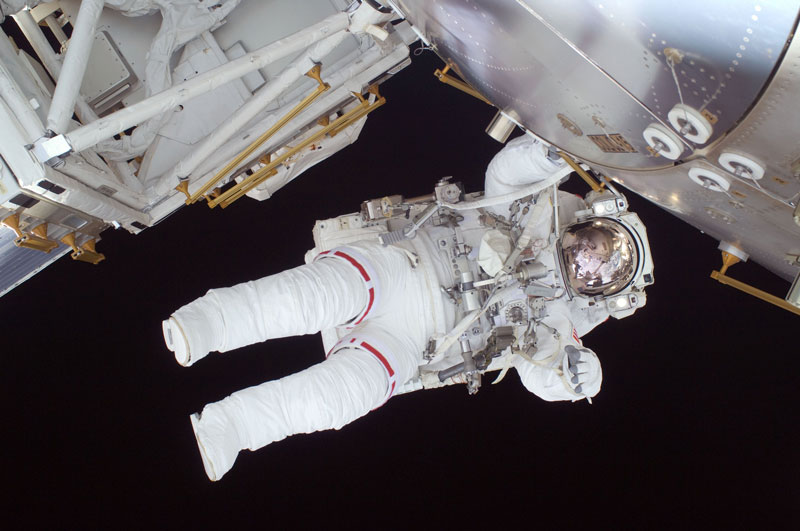
HOUSTON, Texas – An astronaut who recently returned to Earth after his first space mission admits he was devastated to learn the Earth is actually round.
Air Force Lt. Col. Martin Dunlap was a lifelong Flat Earth believer who went to extraordinary lengths, including joining world’s most prestigious space program, to validate his views after thousands of at home experiments failed to disprove the curvature of the planet.
Mankind first discovered that the Earth was spherical in the 3rd century B.C., and it’s been a pretty well-accepted fact ever since. Well, for most people. There is a small subsect of the human population that hangs on to the archaic idea that the Earth is not a large ball of rock spinning around the sun at almost 30 kilometers a second, but a flat disk of dubious speculation.
“I don’t believe we’ve landed on the moon, I don’t believe the Earth is round, and I don’t believe anyone who says otherwise,” Dunlap said in an interview on The Flat Earth Society’s podcast prior to beginning his long and ultimately disappointing journey to space. “I think NASA and the government have been lying to us for years. But I ain’t no sheep and I ain’t gonna to drink their Kool-Aid propaganda. I’ll show them. I show them all!”
Dunlap is the oldest son of Derek and Karen Dunlap, cattle farmers from outside Somerset, Kentucky. He and his brothers Samuel and Hank grew up with the expectation that they would work the family farm as soon as they hit eighteen. College was never in his cards—it probably wasn’t even in his vocabulary—let alone becoming an astronaut and traveling to space.

From an early age, Dunlap remembers being ridiculed by his peers and teachers for his belief that the Earth was flat.
“I remember Mr. Johnson, my fifth-grade teacher, told us the Earth was round and I said, ‘nuh uh, that doesn’t make sense. Prove it,” said Dunlap, also on his podcast interview. “He said somethin’ about Galilecho, or something like that. I guess it was dude from some 10 billion years ago. But that doesn’t make no goddamn sense since the Earth ain’t more than a few thousand years old, I reckon. Plus, my daddy taught me how to use a level when we hung some shelves in my momma’s laundry room. How’s the Earth supposed to be a circle when that bubble says it’s flat as can be?”
Dunlap and his brothers spent many late nights and weekends reading forums to find what tests they could do to prove their teachers and friends wrong. They’d choose the ones they could do at home without any expensive equipment and ones which the forums guaranteed to work. Unfortunately, none of them did.
As the boys got older, Samuel and Hank gave up on the endeavor, claiming the fields they plow were as flat as a cast iron skillet and that was good enough for them. But it wasn’t good enough for Martin. He would continue to invest his time, money, and energy into proving those “meanie head kids at school” wrong. But after countless failures and thousands of dollars invested, he decided to take an extreme next step and join the antithesis of his cause: NASA.
Unfortunately for Dunlap, there wasn’t a world-ending asteroid heading toward Earth that required the expertise of misfit blue collar oil rig operators (or farmers) to save the day. And becoming an astronaut is not as simple as filling out an application at the local Chick-fil-a or submitting your resume through Indeed. According to the NASA website, there are four requirements to become an astronaut:
- Be a U.S. citizen
- Possess a master’s degree in a STEM field, including engineering, biological science, physical science, computer science or mathematics, from an accredited institution.
- Have at least two years of related professional experience obtained after degree completion or at least 1,000 hours pilot-in-command time on jet aircraft.
- Be able to pass the NASA long-duration flight astronaut physical.
So, Dunlap set off to do what no other person in his family had ever done: he applied to college. He started his educational requirements by enrolling at the local Somerset Community College.
His academic career started off well, but after a semester and a half, Dunlap would unfortunately learn that cosmetology actually had nothing to do with the cosmos. After completing his facial application class, he met with his advisor and changed to a Computer Information Technologies major (but he did maintain a cosmetology minor because he found bodily beautification to be a calming experience).
At the end of his five-and-a-half years at SCC, he earned a staggering 2.8 GPA but managed to squeak through with a degree. Upon graduation, Dunlap enlisted in the U.S. Air Force, using his bachelor’s degree to enroll in Officer Candidate School to commission as a second lieutenant, attended flight school, and become a jet pilot.
While assigned to the 19th Fighter Squadron, based out of Joint Base Pearl Harbor in Hickam, Hawaii, Dunlap used the Montgomery G.I. Bill to enroll at the University of Hawaii to earn his master’s degree in computer science.
He deployed on multiple occasions to locations across the Middle East in support of Operation Enduring Freedom, Operation Iraqi Freedom, and Operation Inherent Resolve where he flew more than 400 sorties, earned three Combat Action Medals, the Air and Space Commendation Medal, the Purple Heart, and the Distinguished Flying Cross.
After his final deployment in 2019, Dunlap graduated with his master’s degree and accrued enough flying hours to submit his packet to join NASA and its elite astronaut corps.
“[Dunlap’s] history with the Flat Earthers was not a secret,” said NASA spokesman Dwayne Hickock. “We took one look at his Facebook page, which he didn’t make private, and it was clear to us we had someone who we’d normally eliminate from contention immediately.
“But then we looked at his military record and read the citations for his numerous awards and thought, damn, this dudes a bonafide hero. I wouldn’t be surprised if Steven Spielberg and Tom Hanks make a movie about what he did in Afghanistan someday. So yeah, we let him into the program, but with an abundance of caution.”
Despite Dunlap’s unwavering belief the world was flat, he still managed to outperform most of his peers and earned a spot on of the agency’s final space shuttle missions to the International Space Station.
“There’s a lot of meticulous calculations for telemetry and trajectory that our astronauts need to have concrete understanding of,” said Hickock. “All of which require understanding how the Earth, as a sphere, effects our equipment. How he managed to get through all that and still believe the Earth is flat is, honestly, well beyond me.”
In the early morning of July 11th, Dunlap and his crew sat aboard the space shuttle Atlantis waiting for takeoff.”
“My anxiety was through the roof,” said Dunlap. “I heard the medical officer chime into my ear three or four times prior to the launch. He was concerned about my heartrate, but I was just so damn excited to finally prove what I knew in my heart to be the true.”
After about two days orbiting the Earth, Atlantis docked with the ISS.
“I couldn’t get a good look through the windows to see whether or not the Earth was truly flat,” Dunlap said. “I was disappointed, but I’d put in years of work getting ready for this. I could wait a little longer.”
On the third day, Dunlap suited up for his first spacewalk. This was the moment he’d been waiting for. Time, Dunlap said, felt like it stood still. Finally, after more than a decade of preparations, he stepped out of the ISS with his camera ready. But what he saw was not at all what he was expecting.
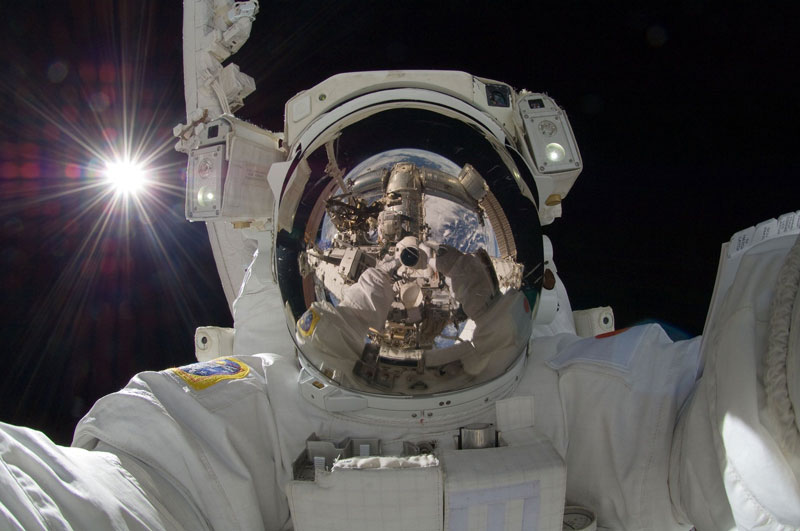
“It’s round. It’s fucking round,” Dunlap said. “Everything they said was true. It was a giant, beautiful blue ball floating in a vast vacuum of space. I was crushed, if I’m being honest. I was very emotional.”
When Dunlap returned to Earth, he was heralded by his local chapter of Flat Earthers with much fanfare. He was a hero, a man who went above and beyond anyone else to expose the truth. Until he shared his story and showed them all the photos he’d take during his spacewalks.
“They called me a liar. They said I was government sell out and banned me from the organization,” said Dunlap. “It hurt in the beginning. I’d set myself on this path because I believed I was more openminded than everyone else, and that I needed to help people see the truth; to clear their minds of the government’s brainwashing. That was my purpose. But the truth was we were so blinded by our hubris that we couldn’t accept all the evidence that disproved our point of view.”
After retiring from the Air Force after twenty-two years of service, Dunlap returned to the family farm. He is currently married with four children and lives a quiet life herding cattle and actively avoiding conspiracy theories.
Sign up for the Alpine 6 Action News newsletter and never miss another article!
Discover more from Alpine 6 Action News
Subscribe to get the latest posts sent to your email.
 Alpine 6 Action News