
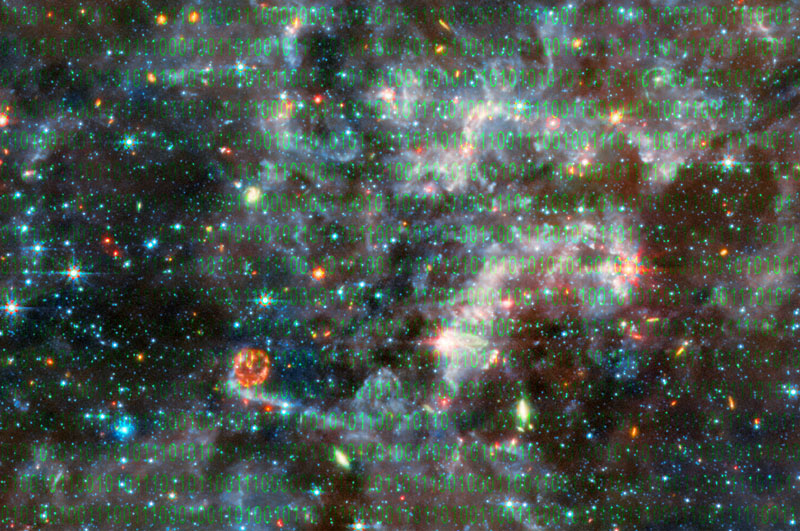
WASHINGTON, D.C. – Scientists using the James Webb Space Telescope have announced they’ve made a history-defining discovery. Using JWST’s state-of-the-art Integrated Science Instrument Module (ISIM) and Optical Telescope Element (OTE), the scientists have looked deeper into space (and further into our universe’s past) than ever before.
They’ve looked so far, in fact, that they’ve confirmed one of the humanity’s most wild conspiracy theories.
“While interpreting the data from the telescope, we began to see anomalies that I, personally, assumed were impossible,” said Dr. Richard Karr, senior project scientist for JWST. “But after each member of our team independently confirmed the data, we can announce with utmost certainty that what we gathered with JWST is remnants of the universe’s original source code and we are, in fact, living in a computer simulated reality.”
This news took the scientific community by storm and researchers around the globe unanimously put their own projects aside to help scrutinize the data. It will most likely take scientists years to fully understand the ramifications of this discovery and, while some are optimistic about what this all means, others have started to question the purpose of their existence.
“I woke up today in a pretty good mood,” said Dr. Victor Sampson, professor at Princton University. “But now I just don’t see what the point is. I have a mortgage, a failing marriage, and a bottomless pit of student loan debt. Why couldn’t we get a cool simulation where everyone was happy all the time?”
“I don’t know man, I see this as a real opportunity,” said Caleb Smith, a white hat hacker working with the U.S. Department of Defense on cyber security. “Computers have vulnerabilities and if we can find and exploit those vulnerabilities, we could make this universe one hell of a place to live. I’m talking infinite money glitch, access to the character creator software, and maybe even activate an endless margaritas and tacos cheat, or something.”
The computer simulation theory was first introduced by philosopher Nick Bostrom in the April 28, 2003, edition of Philosophical Quarterly. Further studies into the theory hypothesized that the probability of our universe being simulated was about 50/50. The reason being that because we haven’t been able to create our own simulation with inhabitants who express free will, our universe is most likely real. However, the moment we’re able to create that simulation, the probability flips and it becomes infinitely more likely that our world is, in fact, a computer program.
On a 2020 episode of the StarTalk Podcast, astrophysicist Neil deGrasse Tyson explained that with our current advances in computer and video game technology, the reality of our world being a simulation wasn’t as farfetched as we may have thought.
“Our computing power is growing rapidly. We create simulations of worlds. We have video games with characters that are inside the video game. Imagine a day where you can simulate a world so perfectly with lifeforms—humans—so well that you can recreate every neurosynaptic thought you could have … including the perception of free will.”
“You don’t have to have all the world existing there at all times, that might be an unrealistic amount of computing power,” said Tyson. “You just need enough of the world that they see around them.”
What Tyson is alluding to is what video game developers commonly refer to as procedural generation. In other words, the game doesn’t expend computing power on areas of the game where the player isn’t physically located but creates it when that area enters the gamer’s point-of-view. This is how some of today’s AAA open-world games are able to have such expansive maps while keeping file sizes relatively low.
In other words, a tree that falls in the forest without anyone around to hear it does not make a sound.
Although we’ve yet to create this level of sophisticated simulation ourselves, JWST’s discovery all but solidifies Bostrom’s theory. As exciting as it is to finally have an answer to the origin of our universe, it’s also provoked more questions than provided answers. For example, are the first simulation or the last?
The simulation theory suggests that each simulation should, at some point, be capable of creating their own simulation, the next link in the chain, if you will. Of course, all these simulations will run off the computing power provided by the original, “real” universe. What this means is that, eventually, there won’t be enough computing power for the lowest level of the simulation chain to power a simulation of their own. This begs the question, if we’ve yet to build our own simulation, have we just not reached the capability to do it or are we so low on the chain there isn’t enough computer power to make it possible?
Only time will tell.
Sign up for the Alpine 6 Action News newsletter and never miss another article!
Discover more from Alpine 6 Action News
Subscribe to get the latest posts sent to your email.
 Alpine 6 Action News