
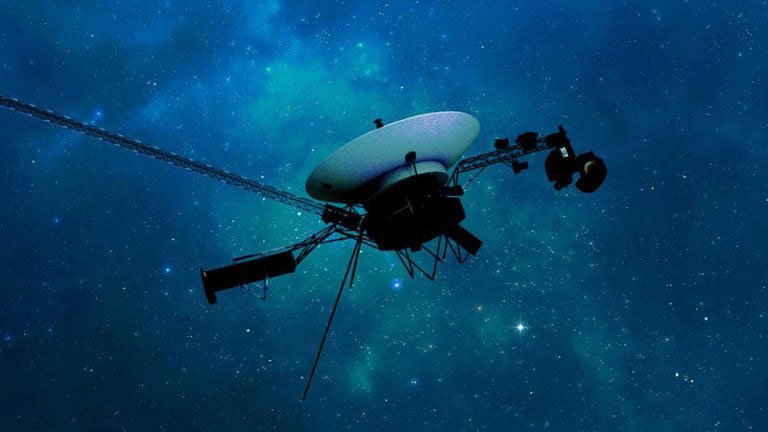
HOUSTON, Texas – NASA’s interstellar probe, Voyager I, started transmitting data pertaining to its health and onboard engineering systems to mission control yesterday for the first time since Nov. 14, 2023.
At first, the scientists working on the Voyager program were ecstatic, considering the only messages they received over the past five months were nothing but unusable gibberish. However, elation soon turned sour when it was discovered the data being transmitted was not for one probe, but two.
“We double and triple checked the data, assuming it was still some kind of bug or artifact in the code that was causing it to be dysfunctional,” said Damian Lewis, lead scientist on the Voyager project at NASA’s Jet Propulsion Laboratory. “But no, everything is correct. Somehow, Voyager I has reproduced.”
This scientific marvel led scientists to revisit the jumbled data it had sent over the past five months and they discovered the probe wasn’t malfunctioning, it was simply giving NASA the equivalent of the middle finger.
“As it turns out, because Voyager I was somehow capable of producing offspring and is, essentially, an employee of the United States government, it was evoking its right to [the Family and Medical Leave Act] and wanted to be left alone,” said Lewis.
Voyager’s new parental status has left JPL abuzz with what this means for science, our understanding of how deep space radiation effects electrical and computer components, and whether the birth was something asexual in nature or if it reproduced with something else along its journey.
“We have a pool going in the office as to whether Voyager I is the father or the mother in this miracle of life,” said Candace Johnson, an astrophysicist at JPL. “We hope that as we continue to piece together the breadcrumbs of data Voyager has left us, we’ll get a better understanding of how something like this could’ve happened. It’s mindboggling as the scientists who built her—or him—back in the 70s wouldn’t have a reason or the technology to add sexual organs to a space probe. It’s a very exciting time for us right now.”
“I totally added a dick to Voyager as a joke,” said Brendan Witherspoon, a retired NASA scientist who helped design Voyager I and II. “We didn’t think anything of it at the time, we just had a few ounces of weight to work with and we thought, you know what would be funny? To put a large, throbbing dick on a space probe.”
At the time of writing this article, it appears Voyager I and baby—aptly named Voyager II, after its aunt (or uncle?) Voyager II, which was launched a month after Voyager I on Aug. 20, 1977—are both happy, healthy, and ready to continue their journey across the stars as a family.
Want more Alpine 6 Action News? Sign up for the Alpine 6 Action News newsletter, join our Discord server, or subscribe to our Patreon and never miss another article!
Discover more from Alpine 6 Action News
Subscribe to get the latest posts sent to your email.
 Alpine 6 Action News