
With the Global War on Terror seemingly winding down after the U.S. announced an agreement with the Iraqi government to gradually end the U.S.-led military coalition’s mission there (again) and America’s withdrawal from Afghanistan in 2021, the active duty Army has been desperately fighting for relevancy after having its budget slashed $5.6 billion last fiscal year.
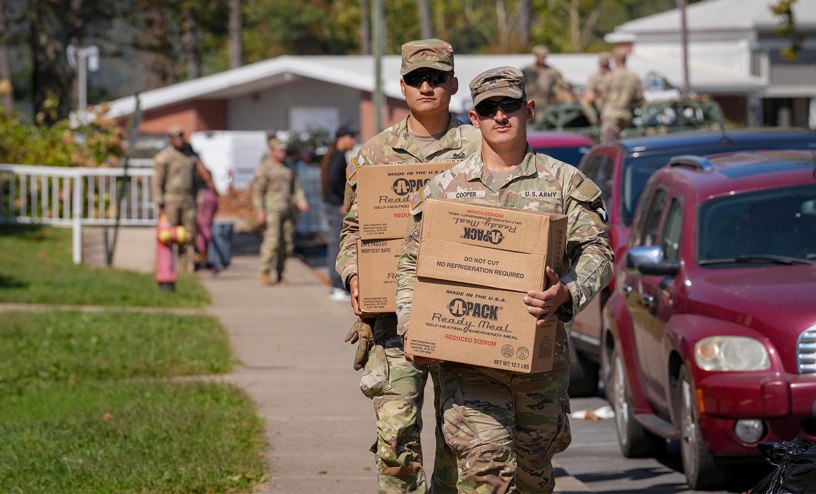
To do this, the Army has begun inserting themselves in domestic operations, such as natural disaster relief, a mission typically reserved for the National Guard—the reserve component that reports directly to their state’s governor for the sole purpose of assisting the state in times of need.
“We’ve noticed active duty soldiers get really bored without wars to fight,” said Col. Hank Humphrey, an operations officer for the 82nd Airborne Division out of Fort Liberty, N.C. “When hurricane Helene hit North Carolina, a bunch of us were sitting at Patty’s Irish Public House having a few drinks and we thought, ‘jeez, this is happening in our back yard. I bet our joes would love to get out there and help their neighbors during this difficult time.’ So, we did what we do best and parachuted into a remote area of the state and began rebuilding these places whether they wanted us there or not.”
Humphrey also said they chose these remote locations because they didn’t want their soldiers mingling with any of the 6,100 National Guardsmen deployed to the state for relief efforts because they didn’t want them to know there was a professional military force that doesn’t live in mold-infested barracks, maintains legitimate civilian careers, and helps Americans in need on a regular basis.
“I know we’re not supposed to view the National Guard as the red-headed stepchild of the military anymore because they actually deploy overseas just as much if not more than us at this point, but we still do because it took us a long time to build up the superiority complex that we have over them and, well, quite honestly we’re jealous of how awesome it sounds,” said Humphrey. “Just imagine not having to move every few years to some shitty base that they stuck in some shitty backwoods area of a state just to wake up at 5 a.m. every morning to do PRT. That sounds awesome.”
At the time of writing this article, more than 1,500 active duty troops from the 82nd and 20th Engineer Brigade, also out of Fort Liberty, are on the ground assisting with the relief efforts. Their arrival comes at a time when disinformation and misinformation about the storm response efforts are raging out of control like a chlamydia outbreak on a young soldier’s genitals after sleeping with a Fayetteville hooker.
“It’s frankly ridiculous, and just plain false,” said Deanne Criswell, leader of the Federal Emergency Management Agency. “This kind of rhetoric is not helpful to people. It’s really a shame that we’re putting politics ahead of helping people, and that’s what we’re here to do. We have had the complete support of the state.”
Criswell also said the constant false information and conspiracy theories, such as when Twitter users accused a North Carolina National Guard UH-60 Blackhawk (which was wrongly identified as a Connecticut National Guard Blackhawk) of purposely destroying an aid station when its rotor wash accidently blew over some tents, was incredibly “demoralizing.”
For Humphrey, however, this is the perfect environment for his soldiers to thrive.
“The soldiers of the 82nd Airborne Division are expertly adept at maintaining extremely high productivity with excruciatingly low levels of morale,” said Humphrey. “As a matter of fact, I think that’s the one thing we have over the National Guard. While they get to go home at night and spend time with their families, we are constantly keeping our soldiers in the office or the motor pool well past 1800, and bring them in on the weekends, just to deconstruct their morale specifically for situations like this.”
Of course, the civilians on the ground don’t give a damn about whether a soldier is on active duty or in the National Guard. When they’re surfing down the river on the roof of their house, any helicopter willing to rescue them is a blessing.
“Is this a National Guard mission? Yes,” said Brig. Gen. Alan Allard, the North Carolina National Guard disaster response commander. “But it says ‘U.S. Army’ over the heart on all our uniforms and we’re always happy to have some extra helping hands, especially up in the mountainous regions that are difficult to get to. But we’re in charge here, they need to remember that.”
With the success of the 82nd Airborne Division, more active duty units are looking at the possibility of sending troops to Florida to help deal with the aftermath of Hurricane Milton, which is already in the process of trying to wipe the state off the map, less than two weeks after Helene battered the state.
“I’ve got a record number of DUI, drug-related, and sexual assault arrest cases sitting in my JAG’s office,” said Lt. Gen. Geoffery Jones, deputy commanding general for 10th Mountain Division out of Fort Drum, New York. “We need to get our soldiers out of the barracks and onto a battlefield somewhere. But until we invade the next country, we need to find something to occupy these young adults’ horny, debaucherous minds. A field trip to Florida does sound nice right now. Winter is coming, after all.”
As the south prepares for Hurricane Milton, what many meteorologists believe may be one of the worst catastrophic events to hit Florida since Katrina in 2005, more potentially devastating weather systems are currently forming in the Atlantic basin. If you’re living in the path of any of these storms, be safe, evacuate, and rest easy knowing the National Guard will be there to see you through (and active duty, too, probably).
Discover more from Alpine 6 Action News
Subscribe to get the latest posts sent to your email.
 Alpine 6 Action News